
 Discussion
Eyes on hATTR amyloidosis: Ocular symptoms and solutions
Last updated March 14, 2024, by Marisa Wexler, MS
 Fact-checked by Patrícia Silva, PhD
Hereditary transthyretin (hATTR) amyloidosis is a genetic disease characterized by toxic clumps of transthyretin protein that cause damage to the body’s tissues. The disease can affect many parts of the body, most often the nerves and heart, but also other areas such as the eyes.
Eye issues are common in hATTR amyloidosis. They can range from dry eyes to sight-threatening complications such as glaucoma. Symptoms can vary substantially from person to person.
hATTR amyloidosis impact on the eyes
hATTR amyloidosis affects the eyes when it causes toxic protein clumps to develop in them. These clumps can obscure vision and set the stage for serious eye problems such as glaucoma.
Eye-related problems are estimated to affect between 10% and 24% of people with hATTR amyloidosis.
hATTR amyloidosis also can affect the eyes indirectly. The disease often causes damage to autonomic nerves, which are nerves that help control unconscious bodily processes including blinking and making tears. Damage to these nerves can contribute to issues such as chronically dry eyes.
Routine eye monitoring is recommended for anyone with the disease. By doing so, any issues can be caught early and addressed before causing major problems.
Common ocular symptoms
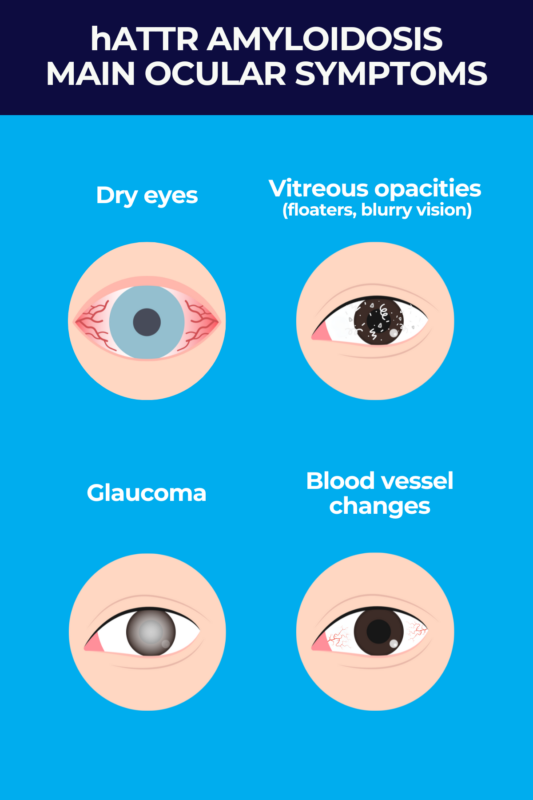
The most common ocular symptoms found in people with hATTR amyloidosis include:
- dry eyes
- vitreous opacities
- glaucoma
- changes in blood vessels in and around the eyes.
Dry eyes
What it is: Dry eye is the most common eye symptom from hATTR amyloidosis. It is estimated that up to 80% of people experience some degree of dry eyes. The symptom can occur in all stages of the disease. In severe cases, dry eyes can damage the eye’s surface and affect vision.
Treatment and management: Treatment is generally the same as it would be for someone with dry eye who does not have hATTR amyloidosis. It can be managed with eye drops to keep the eye moist and lubricated. In some severe cases, surgery may be recommended to help keep eyes moist.
Vitreous opacities
What it is: Clumps of proteins that form in the eyeball are known as vitreous opacities — meaning a shape in the vitreous, which is the jelly-like substance that fills much of the eye. Vitreous opacities are estimated to affect up to 35% of patients. Vitreous opacities can cause problems including blurry vision and “floaters,” where a person sees a shape that floats across a particular spot in their vision. Over time it may cause painless, progressive loss of vision.
Treatment and management: The main method for treating vitreous opacities is vitrectomy, a surgical procedure to remove and replace the eye’s jelly-like vitreous. This procedure is generally effective for restoring vision in the short term. Over the long term, it’s fairly common for vitreous opacities to reappear, which can require additional surgeries to remove them.
Glaucoma
What it is: Glaucoma is characterized by an increased pressure in the eye that can damage the optic nerve, which connects the eyes to the brain. Glaucoma is one of the most common causes of blindness for people with hATTR amyloidosis. It is estimated to affect 5%-27% of patients.
Treatment and management: Although there are medications to treat glaucoma, they typically aren’t very effective in people with hATTR amyloidosis. For this reason, treatment of glaucoma in people with hATTR amyloidosis mainly relies on trabeculectomy, which is a surgical procedure to reduce eye pressure.
Blood vessel changes
What it is: The majority of people with hATTR amyloidosis have abnormalities in blood vessels in and around the eye. While most of these are harmless, some hATTR amyloidosis patients experience more pronounced changes that can set the stage for bleeds in the eye and other complications. In severe cases, it can lead to blindness.
Treatment and management: When significant bleeds occur in the eye, treatment generally involves laser photocoagulation, where a precise beam of light is used to stop the bleeding.
Other eye symptoms
When someone has hATTR amyloidosis, the pupil (the black center of the eye) may have an uneven edge, referred to as a “scalloped” pupil. It can be an early sign of glaucoma risk and require more intensive monitoring.
Due to protein clumps in the lens of the eye, people with hATTR amyloidosis may develop cataracts — when the lens of the eye becomes clouded. Treatment for cataracts is the same whether or not someone also has hATTR amyloidosis. Typically, the clouded lens will be surgically removed and replaced with a healthy one.
Amyloidosis News Today is strictly a news and information website about the disease. It does not provide medical advice, diagnosis, or treatment. This content is not intended to be a substitute for professional medical advice, diagnosis, or treatment. Always seek the advice of your physician or other qualified health provider with any questions you may have regarding a medical condition. Never disregard professional medical advice or delay in seeking it because of something you have read on this website.
Related articles
-
Discussion
-
 Discussion
-
 Discussion
-
 Discussion
-
 Discussion
-
 Discussion