ATTR-CM treatment
 Fact-checked by
 The treatment of transthyretin amyloid cardiomyopathy (ATTR-CM) is a multidisciplinary effort involving interventions to slow disease progression and manage symptoms.
ATTR-CM is a form of amyloidosis, where protein clumps, called amyloid deposits, accumulate in tissues. For ATTR-CM in particular, amyloid deposits composed of a misfolded version of the transthyretin (TTR) protein accumulate in the heart, disrupting its function. This can be caused by genetic mutations (hereditary ATTR-CM) or other age-related processes (wild-type ATTR-CM).
The treatment options for ATTR-CM may vary depending on the type of disease and specific symptom profile.
Approved treatments for ATTR-CM
Currently, there are three approved ATTR-CM treatments in the U.S.:
These disease-modifying therapies are all approved to reduce heart-related hospitalizations or death in adults with hereditary and wild-type ATTR-CM.
TTR silencers
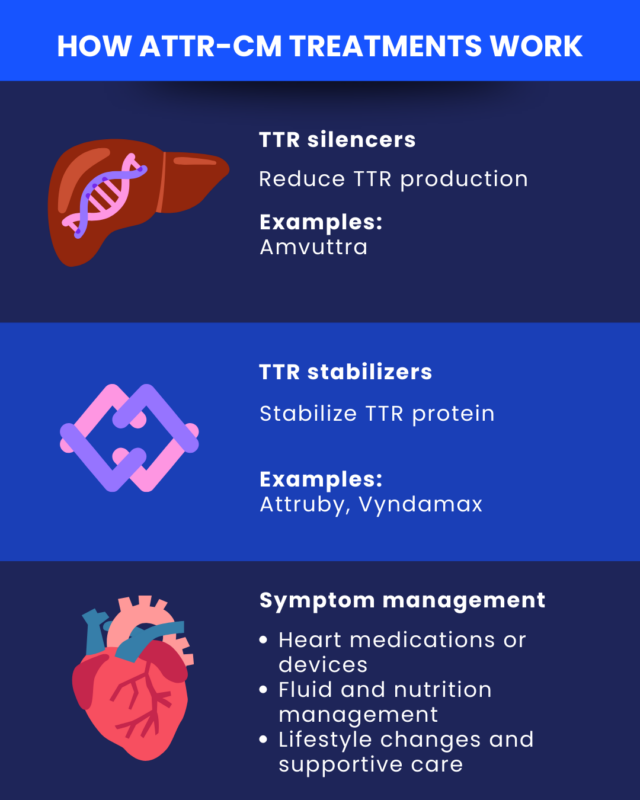
Gene silencing therapy for ATTR-CM works to prevent amyloid deposits from forming by lowering TTR production. These treatments reduce the activity of the TTR gene, which is responsible for producing the TTR protein.
Amvuttra is the only TTR silencer that’s approved for ATTR-CM in the U.S. It is delivered as an under-the-skin injection once every three months. The therapy has also been approved in the U.S. to treat a related condition called hereditary ATTR amyloidosis with polyneuropathy (hATTR-PN), in which TTR primarily accumulates in the nervous system.
Historically, liver transplants have been used as a way to effectively silence a faulty TTR gene in hereditary ATTR-CM, allowing the production of a healthy TTR protein from non-mutated cells in the new liver. However, with the advent of effective disease-modifying medications, this is now uncommonly used as an ATTR amyloidosis treatment.
TTR stabilizers
TTR amyloid deposits form when the usual four-part protein structure falls apart, and its pieces misfold and clump together. The TTR stabilizers Attruby and Vyndamax act like a molecular glue that holds the TTR protein structure together, preventing misfolding and amyloid buildup.
Vyndamax is a selective TTR stabilizer that’s designed to bind to specific sites within the TTR protein, stabilizing it and slowing its dissociation into individual pieces. It’s available as oral capsules to be taken once daily.
Attruby is a next-generation TTR stabilizer that’s designed to have a stronger hold on TTR by mimicking the effects of a naturally occurring gene mutation that protects against amyloid formation. It’s taken twice daily in the form of oral tablets.
Investigational and emerging therapies
Several investigational disease-modifying therapies are being tested in clinical trials for ATTR-CM. These emerging therapies for amyloidosis fall primarily into three categories:
- gene silencing drugs
- gene-editing medications
- amyloid-clearing therapies
Eplontersen is a gene silencing therapy that’s already approved under the brand name Wainua for treating hATTR-PN and is in Phase 3 testing for ATTR-CM.
Gene-editing therapies also aim to lower TTR gene activity to reduce TTR production. But unlike gene silencers, these medications directly alter the DNA sequence. An example is nexiguran ziclumeran (nex-z), which is currently in Phase 3 testing for ATTR-CM.
Amyloid-clearing therapies aim to reverse disease progression by encouraging the immune system to remove existing amyloid deposits. The experimental amyloid-clearing treatments coramitug and cliramitug are in Phase 3 testing for management of ATTR-CM.
Managing symptoms and heart health
In addition to targeted ATTR-CM therapy, ATTR-CM treatment may require interventions to manage cardiac symptoms.
- Salt and fluid management is key for limiting the excess fluid that accumulates when the heart can’t pump blood effectively. This may include dietary changes and heart failure medications, such as mineralocorticoid receptor antagonists and diuretics.
- Heart rhythm abnormalities may be managed with medications, or in more severe cases, pacemakers or cardioverter-defibrillator devices.
- In advanced cases where the heart is severely damaged, a heart transplant may be considered.
Heart failure management in ATTR-CM can be challenging because some standard heart medications, particularly those used to reduce blood pressure, are poorly tolerated in this patient group.
Other interventions may be used to manage symptoms outside the heart. Regular follow-up with a team providing multidisciplinary care for ATTR-CM can help track symptoms and determine the best approach for managing symptoms of ATTR-CM.
Supportive and lifestyle changes
Supportive care in ATTR-CM aims to optimize life quality and minimize the impact of the disease on everyday life. This may involve lifestyle changes such as:
- restricting salt and fluid intake and eating a heart-healthy diet
- increasing physical activity as tolerated
- closely monitoring symptoms and blood pressure, and promptly reporting changes to a healthcare provider
- relaxation practices and controlled pacing of activities to manage symptoms like fatigue and shortness of breath
Patients and caregivers may also benefit from counseling or support groups, which offer spaces for emotional processing and community building. Genetic counseling can help people with hereditary ATTR-CM understand the implications of genetic test results for treatment, prognosis, and family risk.
Amyloidosis News Today is strictly a news and information website about the disease. It does not provide medical advice, diagnosis, or treatment. This content is not intended to be a substitute for professional medical advice, diagnosis, or treatment. Always seek the advice of your physician or other qualified health provider with any questions you may have regarding a medical condition. Never disregard professional medical advice or delay in seeking it because of something you have read on this website.