Cliramitug for ATTR-CM
 Fact-checked by
 What is cliramitug for ATTR-CM?
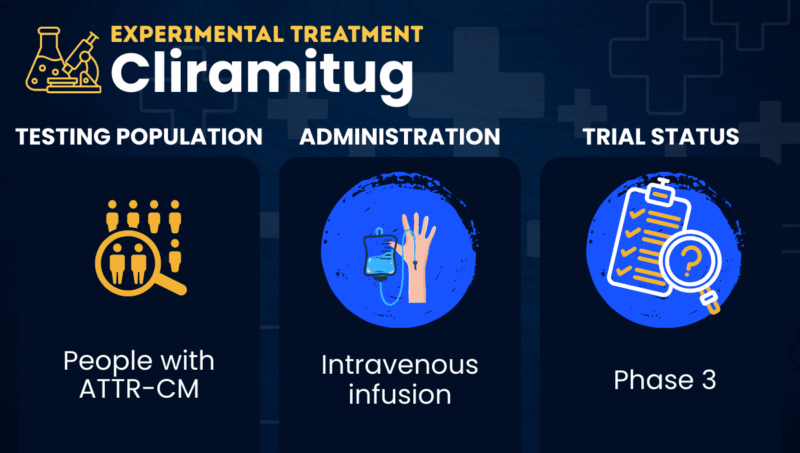
Cliramitug (also known as ALXN2220 or NI006) is an experimental, antibody-based therapy being tested as a possible treatment for transthyretin amyloid cardiomyopathy (ATTR-CM). It is given via into-the-vein (intravenous) infusions.
In ATTR-CM, the protein transthyretin becomes structurally unstable, breaking into subunits that are prone to misfolding and clumping together. These clumps, known as amyloid deposits, accumulate in the heart and impair its function, driving disease symptoms.
Currently available ATTR-CM therapies work in different ways to prevent new amyloid deposits from forming, but they are not able to clear existing deposits.
Cliramitug works by binding to abnormal forms of transthyretin, marking them for clearance by the immune system, but leaves transthyretin in its healthy, stable form unaffected. This is expected to help clear damaging amyloid deposits from the heart, easing symptoms and potentially slowing or reversing disease progression.
Neurimmune and Alexion, AstraZeneca Rare Disease, are codeveloping cliramitug, which is currently in Phase 3 testing for ATTR-CM. The therapy has been granted fast track status in the U.S., which is intended to expedite its clinical development and regulatory review.
Therapy snapshot
| Treatment name | Cliramitug |
| Administration | Intravenous infusion |
| Clinical testing | Currently in Phase 3 testing for ATTR-CM |
How will cliramitug be administered in ATTR-CM?
In clinical trials, people with ATTR-CM have received cliramitug as intravenous infusions, given once every four weeks at a weight-based dose. Multiple dose levels were tested in early studies; the Phase 3 trial dose has not been publicly released.
Cliramitug in ATTR-CM clinical trials
A Phase 3 trial called DepleTTR-CM (NCT06183931) is now testing cliramitug at 212 locations worldwide. The trial enrolled more than 1,100 adults with wild-type or hereditary ATTR-CM, who were randomly assigned to receive monthly infusions of cliramitug or a placebo for at least two years, and up to four years.
The study’s main goal is to assess the incidence of death from any cause, as well as events related to cardiovascular problems. Heart disease-related quality of life and exercise capacity is also being assessed. DepleTTR-CM is expected to finish in 2027.
A previous Phase 1 trial called NI006-101 (NCT04360434) tested multiple doses against a placebo in 40 adults with wild-type or hereditary ATTR-CM and chronic heart failure. The results showed that:
- biomarkers of heart damage and surrogate imaging measures of amyloid buildup in the heart tended to decrease with cliramitug, which was sustained long-term in two open-label extension periods
- measures of heart structure and function demonstrated sustained improvements
An ongoing follow-on Phase 2 trial called NI006-102 (NCT07213583) is now testing the safety and efficacy of cliramitug re-treatment in former NI006-101 participants. The year-long study is expected to finish in 2026.
Cliramitug side effects
In NI006-101, there were no serious safety events related to cliramitug. The most common safety events were heart failure and abnormal heart rhythms, known as arrhythmias, which are common and expected complications in people with ATTR-CM.
Data from ongoing Phase 3 studies are expected to provide more information about the specific side effects that cliramitug may cause in people with ATTR-CM.
Amyloidosis News Today is strictly a news and information website about the disease. It does not provide medical advice, diagnosis, or treatment. This content is not intended to be a substitute for professional medical advice, diagnosis, or treatment. Always seek the advice of your physician or other qualified health provider with any questions you may have regarding a medical condition. Never disregard professional medical advice or delay in seeking it because of something you have read on this website.