Screening and diagnostic tools in hATTR amyloidosis
Last updated March 14, 2024, by Marisa Wexler, MS
 Fact-checked by Patrícia Silva, PhD
Hereditary transthyretin amyloidosis, also known as hATTR amyloidosis, is a genetic disorder caused mainly by mutations in the TTR gene. The TTR gene provides instructions for making a protein called transthyretin. In hATTR amyloidosis, an abnormal form of the transthyretin protein is produced, which then forms toxic clumps that damage the body’s tissues, especially the heart and nerves.
Early detection
Multiple therapies are now available that can slow the disease’s progression, helping to improve the outlook for people with hATTR amyloidosis. The availability of these treatments makes early detection even more important in the care for this rare disorder. The goal is to start treatment as soon as possible after hATTR amyloidosis symptoms first appear as a way to stop or delay disease progression as much as possible.
Because hATTR amyloidosis is a genetic disorder, it can run in families. Having a known family history of the disease may help in getting an hATTR amyloidosis diagnosis sooner as it may prompt a doctor to test for it.
Genetic testing can identify people with hATTR amyloidosis before symptoms develop, so it may be recommended for people with a family history.
Diagnosing hATTR amyloidosis is usually more difficult in people who don’t have a known family history, either because the person is the first in their family with hATTR amyloidosis or because other members of their family who had the disease were never diagnosed with it.
Because hATTR amyloidosis symptoms are often nonspecific and vary from person to person, it’s common to go years before getting an accurate diagnosis. This often means a person will need to advocate for themselves and even possibly help educate their healthcare team.
Some of the “red flag” symptoms that might lead to being tested for hATTR amyloidosis, when also experiencing abnormal sensations and movement issues that worsen over time (progressive sensorimotor neuropathy), are:
- carpal tunnel syndrome in both wrists
- alternating bouts of constipation and diarrhea
- cardiac issues
- early autonomic dysfunction, such as an unexplained drop in blood pressure when rising from a seated or lying position (orthostatic hypotension), or erectile dysfunction
- unexplained weight loss
- kidney issues
- floaters (vitreous opacity) in the eyes.
Peter Gorevic, MD, professor emeritus of medicine with a specialty in rheumatology at the Icahn School of Medicine at Mount Sinai in New York City, says that the medical community now is diagnosing people with amyloidosis at an earlier stage.
“We see these patients much, much earlier. We see them because we have better tests. … We see them because we have the genetic tests that we can offer if it seems appropriate to do it, “ Gorevic says. “And that means that we’re picking up the condition earlier and earlier.”
He explains the increase in early diagnosis is also because of what he refers to as bias of ascertainment.
“Bias of ascertainment means that if you have somebody in your family that has amyloid, you watch out for it,“ he says. “I’ve lost count of the number of people who get referred to me, who come in and say, ‘I don’t know that I have amyloid, I’m worried that I have amyloid, my brother died of amyloid, or I had an uncle who died of amyloid.’ People appreciate that it could be very important to sort out.”
Diagnostic tools
Genetic tests and biopsies
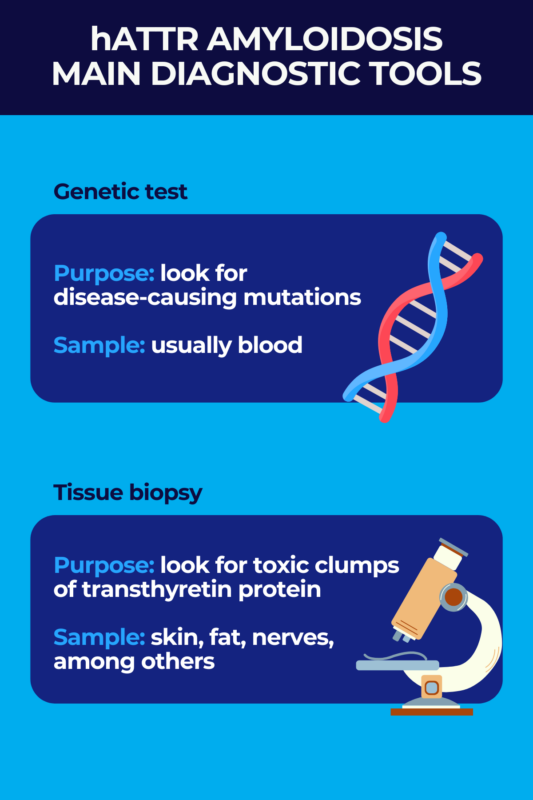
The gold standard for diagnosing hATTR amyloidosis is genetic sequencing that looks for disease-causing mutations in the TTR gene. This type of test is usually done on a blood sample.
Genetic testing can confirm a diagnosis of hATTR in people who already have symptoms. Or it can be used to look for disease-causing mutations in people who have a family history of the disease even before symptoms develop. In some cases, identifying the specific type of disease-causing mutation may provide useful information about the likely course of the disease.
Another diagnostic test for hATTR amyloidosis is a biopsy. A biopsy involves taking a tissue sample from a person that is examined at a lab to check for toxic clumps of transthyretin protein — a telltale sign of the disease.
The biopsy can be done on various tissues, including the skin, fat, nerves, kidneys, intestines, or even the heart in some cases. Where the sample is taken from will depend on the specific situation. Usually, the goal is to biopsy an area of the body that is actively affected by symptoms.
Technically, either a positive genetic test or biopsy can be enough to confirm a diagnosis of hATTR amyloidosis. But the genetic test can’t determine if a patient is actively experiencing toxic protein clumps, and a biopsy can’t definitively determine if protein clumps are due to a genetic mutation. When both options are available, hATTR amyloidosis testing often combines the two tests to establish a definitive diagnosis.
Other tests
Genetic testing and biopsies can establish a diagnosis of hATTR amyloidosis, but they don’t offer detailed information about how the disease is affecting the person. Other tests that may be done to determine how hATTR amyloidosis is affecting a person’s body include:
- nerve conduction studies and electromyograms (EMGs), which can detect signs of nerve damage
- a specialized type of imaging of the heart called scintigraphy, which can determine if there are toxic transthyretin protein clumps in the heart tissue
- blood tests, which can identify markers of organ damage, especially damage to the heart or kidneys
- eye assessments to check for signs of eye involvement.
Amyloidosis News Today is strictly a news and information website about the disease. It does not provide medical advice, diagnosis, or treatment. This content is not intended to be a substitute for professional medical advice, diagnosis, or treatment. Always seek the advice of your physician or other qualified health provider with any questions you may have regarding a medical condition. Never disregard professional medical advice or delay in seeking it because of something you have read on this website.
Related articles