Eplontersen for ATTR-CM
 Fact-checked by
 What is eplontersen for ATTR-CM?
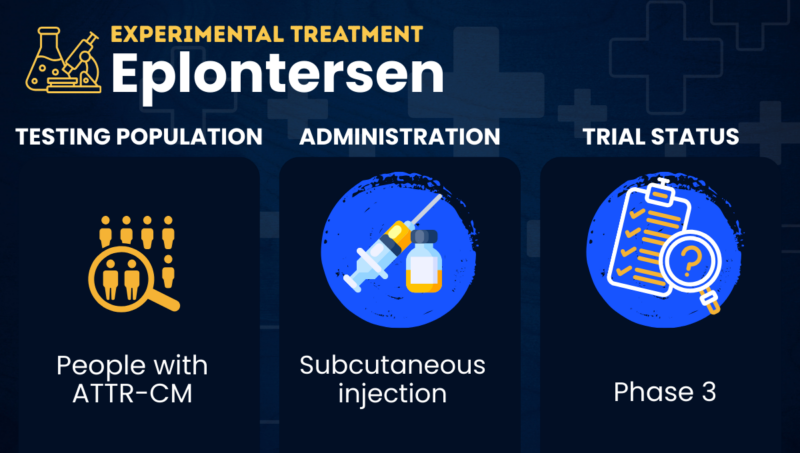
Eplontersen is an experimental gene-silencing therapy being developed to treat transthyretin amyloid cardiomyopathy (ATTR-CM). It’s given via subcutaneous, or under-the-skin, injections.
In ATTR-CM, an unstable transthyretin protein breaks down into components that are prone to misfolding and accumulating in clumps called amyloid deposits. When these deposits form in the heart, they impede its function, leading to symptoms of heart failure. The disease can be genetic (hereditary) or age-related (wild-type).
Eplontersen is designed to reduce the activity of the TTR gene that is responsible for producing transthyretin. It contains a genetic fragment called an antisense oligonucleotide that binds to the template molecule that cells need to make transthyretin, marking it for destruction. This should lower transthyretin production, helping to prevent the formation of new amyloid deposits.
Ionis Pharmaceuticals and AstraZeneca are co-developing eplontersen, which is already approved under the brand name Wainua (Wainzua in Europe) for treating a related disease called hereditary transthyretin amyloidosis with polyneuropathy (hATTR-PN) that mainly affects the nervous system.
The treatment is currently in Phase 3 testing for both hereditary and wild-type ATTR-CM. In the U.S., it holds fast-track status for ATTR-CM and has been granted orphan drug status for all forms of transthyretin-mediated amyloidosis. These designations are granted to expedite the clinical development and regulatory review of the therapy.
Therapy snapshot
| Treatment name | Eplontersen |
| Administration | Subcutaneous injection |
| Clinical testing | Currently in Phase 3 testing |
How will eplontersen be administered in ATTR-CM?
In a Phase 3 clinical trial involving people with ATTR-CM, eplontersen was administered via subcutaneous injections every four weeks, at a dose of 45 mg.
This is the same dosing regimen of Wainua that’s already approved for people with hATTR-PN.
Eplontersen in ATTR-CM clinical trials
Eplontersen is being evaluated for ATTR-CM in an ongoing Phase 3 trial called CARDIO-TTRansform (NCT04136171). The study enrolled 1,438 adults with ATTR-CM who are receiving monthly injections of eplontersen or a placebo, in addition to vitamin A supplements and standard-of-care treatment, for 140 weeks, or more than 2.5 years.
- The study’s main goal is to compare the rates of cardiovascular-related clinical events and mortality between the two groups. Exercise capacity, heart disease-related quality of life, and other clinical outcomes will also be evaluated.
- In parallel with the main trial, two imaging sub-studies, each involving up to 150 participants from the Phase 3 trial, will monitor changes in amyloid buildup in the heart. One will be an MRI-based study (NCT06073574) and the other is a scintigraphy-based study (NCT06073587).
- After CARDIO-TTRansform, all participants may be eligible to join an open-label extension study (NCT05667493), in which all will receive eplontersen for up to three years. Safety, quality of life, exercise capacity, and transthyretin levels will be monitored.
A previous Phase 3 study, called NEURO-TTRansform (NCT04136184), supported the approval of Wainua for hATTR-PN. However, a subset of participants also had cardiac involvement. In those people, eplontersen was associated with stabilization or improvement in measures of heart structure and function.
Eplontersen side effects
As clinical trials are ongoing, the safety profile of eplontersen in people with ATTR-CM has not yet been established. In people with hATTR-PN, the most common side effects are:
- low levels of vitamin A
- vomiting
Prescribing recommendations suggest that patients should take vitamin A supplementation and be monitored for eye problems, which may indicate vitamin A deficiency.
Amyloidosis News Today is strictly a news and information website about the disease. It does not provide medical advice, diagnosis, or treatment. This content is not intended to be a substitute for professional medical advice, diagnosis, or treatment. Always seek the advice of your physician or other qualified health provider with any questions you may have regarding a medical condition. Never disregard professional medical advice or delay in seeking it because of something you have read on this website.